
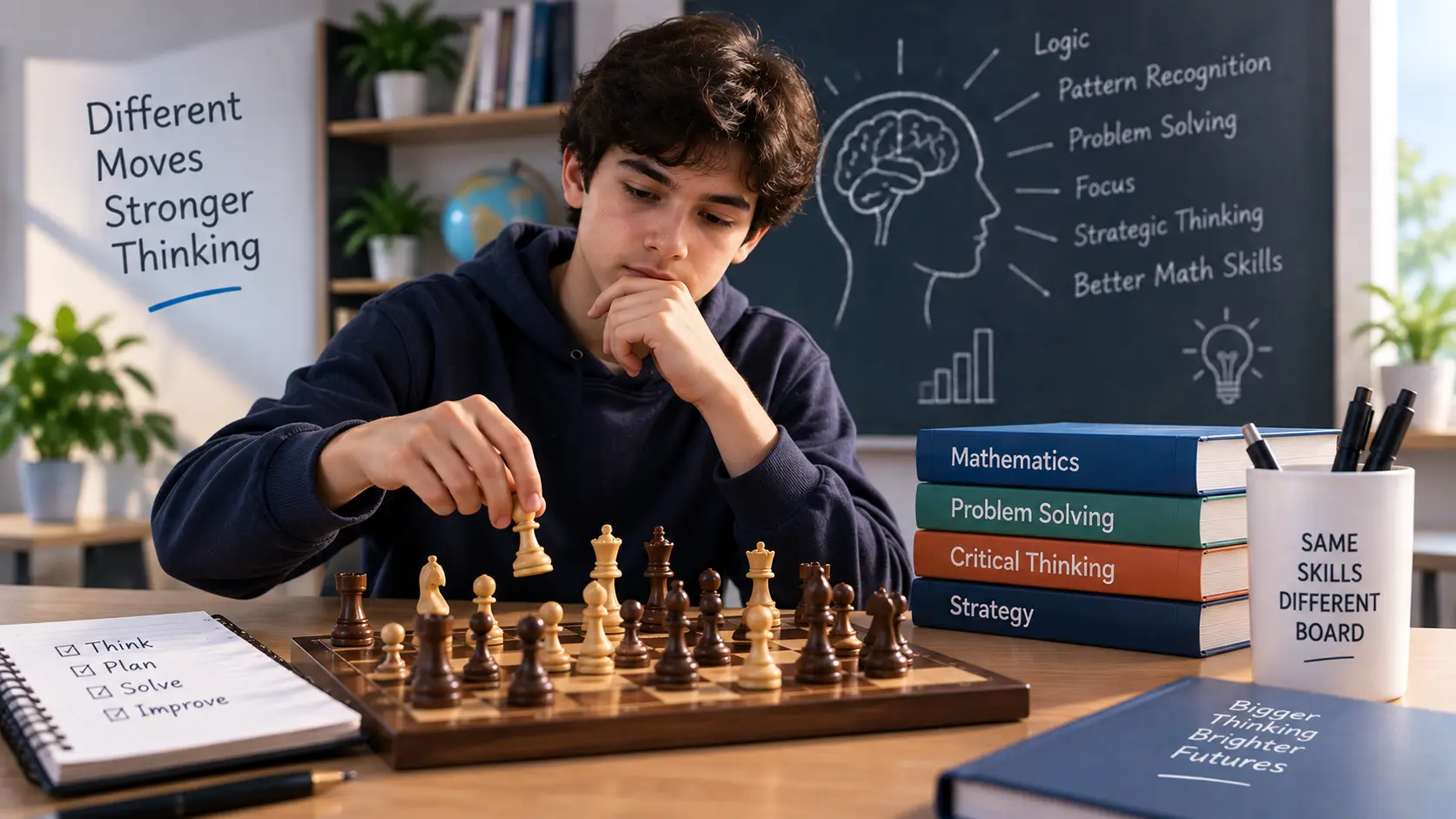
Chess and Learning Does it works?
Chess makes kids smarter at math. You hear it everywhere. Schools run chess clubs on the promise, parents sign kids up hoping for an edge, and it feels obviously true, since both chess and math run on logic, patterns, and thinking ahead.
The reality is more honest than the marketing. Researchers have studied this for decades, and the answer is a qualified maybe, with real benefits, overstated ones, and a few catches worth knowing.
Does Chess Improve Math Skills? What the Research Really Says
The most-cited evidence is a 2016 meta-analysis by Giovanni Sala and Fernand Gobet, pooling 24 studies and more than 5,000 students. It found a moderate overall benefit from chess instruction, stronger for math than for reading. On paper, that backs the popular belief that chess and math skills move together.
There is also a dose effect. Benefits only appeared after roughly 25 to 30 hours of instruction, about one lesson a week across a school year. A few casual games will not do much.
So the early picture looks encouraging. Then the same researchers dug deeper, and it got complicated.
The Catch: Why Some Scientists Are Skeptical
Here is the part most articles skip. When Sala and Gobet examined how those studies were designed, they found a serious flaw. Almost none used an active control group.
The idea is simple. In most studies, the chess group was compared against students who did nothing special. So when the chess kids improved, we cannot be sure chess caused it. It might have been the novelty, the extra attention from an enthusiastic teacher, or the excitement of a new activity. That is a placebo effect, and it inflates results.
When the researchers ran better experiments, comparing chess against another genuinely engaging activity rather than against nothing, the math benefit largely vanished. A large UK study found no lasting difference in math scores between children who learned chess and those who did not.
Their broader conclusion was blunt. Far transfer, the idea that a skill learned in one area automatically boosts a completely different one, is very hard to achieve and may be a myth. Transfer tends to be near transfer only, improving things closely related to the skill, not distant subjects.
So does chess turn children into better math students on its own? The strong version of that claim does not hold up. That does not make chess useless. It means we have been telling the story wrong.
The Cognitive Benefits of Chess That Actually Hold Up
If chess does not magically transfer to math, why do good educators still value it? Because the modest benefits are real.
Chess develops what researchers call non-specific skills, habits of mind that support learning across subjects. Serious play asks a child to concentrate for long stretches, sit with a hard problem instead of quitting, resist moving too fast, and hold several options in mind at once. Persistence, focus, self-control, and working memory all get exercised.
None of those are math skills exactly. But every one helps a student working through a tricky math problem. A child who has learned through chess to slow down, check their thinking, and not panic when the answer is not obvious is better equipped for math, even though the chess taught no math.
There is a narrower overlap too. Chess builds real familiarity with spatial relationships, planning several steps ahead, and if-then reasoning. That sits closer to mathematical thinking than memorizing facts does. Chess is not a math tutor, but it is not unrelated either.
How Strategic Thinking Skills Develop Over the Board
The most durable benefit is the way chess trains strategic thinking skills.
Every move is a small exercise in consequence. If I go here, what can my opponent do, and then what would I do? A player constantly builds and tests short chains of reasoning, then adjusts as the board changes. That is genuine problem-solving practice, repeated hundreds of times a game.
Kids who play regularly get better at pausing before acting, weighing options, and thinking about outcomes rather than reacting. That deliberate pause before a decision matters far beyond the board. It shows up in how a student approaches a word problem or a science experiment.
The key point is that chess practices this skill directly. It does not donate it to math automatically. The student still has to carry the habit across, and good teaching helps that happen.
Seek2Lrn Tip
Do not just let a child play in silence. Ask them to explain why they made a move. Talking through the reasoning out loud is what turns a game into real thinking practice, and it is the same skill they need to explain how they solved a math problem.
The Real Benefits of Chess for Students
Step back from the narrow math question and chess looks genuinely worthwhile, just for slightly different reasons than the hype claims.
It builds patience and resilience, since losing is part of the game and children learn to recover and try again. It rewards concentration in a distracted world. It gives quieter kids an arena where careful thinking wins. It is cheap, portable, and genuinely fun, and engaged children learn more than bored ones.
That is a stronger case than a shaky promise about test scores. Chess is worth playing because it builds focus, patience, and careful thinking, and because kids enjoy it. If it also nudges math confidence along through better study habits rather than magic, that is a welcome bonus.
Should Your Child Play Chess to Get Better at Math?
Here is the balanced takeaway. If you expect chess alone to raise a math grade, temper that hope, because the evidence does not support it strongly. Chess is not a substitute for learning and practicing math.
But if you see it as one good way to build focus, persistence, and strategic thinking that support every subject, it is worth encouraging. Pair it with direct math practice and you get the best of both. The game builds the habits of mind, and the math work builds the math.
Strong math thinkers are not the ones who found a shortcut. They are the ones who learned to think carefully, stay patient, and keep going when the answer is not obvious. Chess can help build that temperament. It cannot replace the work.
Where Focused Learning Comes In
Chess develops the how of thinking. Turning that into strong math performance still takes direct, structured practice, ideally with feedback from someone who can see where a student’s reasoning breaks down.
That is where Seek2Lrn fits. It connects students with tutors for one-on-one sessions and structured learning built around their goals. For a child who has good thinking habits but needs help turning them into real math skill, personalized guidance bridges the gap.
The real lesson holds. Great math thinkers are made through curiosity, patience, and practice. Chess helps set the stage. The learning still has to happen.
